Showing posts with label Fantasy. Show all posts

Tuesday, May 29, 2012

What Shelob Taught Me

*THE TWO TOWERS BOOK SPOILERS HEREIN*

A friend (Faylor's player) had just finished J.R.R. Tolkien's The Two Towers and expressed that the reason the book is so fulfilling is because it satisfies a desire for both "high" and "low level" adventure. I thought for a while about what he meant -- the more I did, the more I agreed with him. 


Whenever I witness a particularly mighty character in fiction my first question always is, 'how did he/she get that way?' In one chapter of The Two Towers readers witness powerful heroes capable of dreadful slaughter. But the reader witnesses the separate and pitiable trudge of the remaining fellowship in the very next chapter. But most interesting to me, is the transition or 'leveling' the hobbits undergo.

I've been thinking about how Tolkien's telling of Sam's battle against Shelob informed the original designs of Gygax and Arneson. The hobbits are 'low level' in comparison to the rest of the fellowship. As such they must rely more on guile than force to accomplish their goals. Sneaking past a few orcs is a feat, but slaying a monster as vile as Shelob is an altogether more epic challenge. Such would take much grit and careful cunning.

Perhaps this is why 'magic items' have become such a staple in most iterations of the classic game. The 'Phial of Galadriel' as well as the elven forged 'Sting' are essential to Sam's survival against the psuedo-mythic spider-demon, Shelob. Even a hobbit of Sam's resolve couldn't survive against such a threat without the aid of supernatural means. And though victorious, the battle left Sam exhausted to his absolute capacity in enemy territory.

Both in DnD and LotR, magic items don't substitute hard-won experience. But they do provide the necessary edge to perhaps offer survival in an otherwise impossible encounter. Because all low level encounters are potentially lethal, every decision must be made with the absolute strategic proficiency to prevent untimely character deaths.

Because magic is limited in LotR as it is in DnD -- low level players/ characters are desperate for creative solutions. Sam's seemingly counter-intuitive assault from beneath was just the unexpected strategy he needed to wound the beast. In all likelihood Sam would have been killed had he not eventually driven the beast away with the elvish phial's light.

Oddly the turning of Shelob seemed akin to the DnD cleric's 'turn undead' ability. And yet arguably Sam's first strike is comparable to a thief's 'sneak attack.' Of course, as treasure equates experience, perhaps it's not quite fair to rate Sam and Frodo as low level.

Indeed both have remarkable elvish gifts as well as the Ring of Power. But even if Tolkien's texts dont seamlessly translate into the DnD experience,  the influence is sufficient enough that I personally enjoy 'low level' DnD more than the advanced levels. For me, low level character-growth is more palpable and satisfying.

Saturday, May 5, 2012

The Numen

Elves call them spirits, men call them demons, dwarves call them gods. The numinous forces of the standing races can be divided into two categories. The first group, called "The Forgotten" are the class of gods which no longer respond to the appeals of worshippers. These are entities so ascendant that even the power of prayer is of little concern to them. These gods are in an eternal political struggle with the other master powers. The Forgotten rarely manifest on the material plane, but send pawn lesser deity's if necessary.


Picture Link. 

The second class of deity are are called "The Singers." These are the mouthpieces of faith and the architects of cults. These are the lesser gods who cringe before the greater gods. But it is the duty and the honor of the Singers to make men bow. Whether through service to the material plane or through its domination, The Singers are the forces that meddle in the affairs of elves, dwarves, and mortals. For a Singer to ascend, they must first enrapture the masses into prayer. The faith-force of the devout directly empowers a Singer. A cult's power grows with the deeds of deity's champions. As the masses are inspired, the deity feeds on their devotion with a dreadful gluttony.

Thursday, May 3, 2012

The Eldar

The elves in my home-brew are inspired by several sources, but Frank Herbert's Dune is the primary influence. The elves in my campaign are in the vein of Herbert's fremen; supreme survivors conditioned by the hell-blasted desert. They are mystic warriors who worship martial and magic cults. Though the aesthetic is  certainly fremen, thats really as far as the similarities go. These elves worship magic as men worship gods. Males follow one cult, females the other.  The elves were the first race to hear the whisperings of magic from the spirits. The eldar mother chose the cult of the *Nightblade. The son-father found the cult of the *Spellsword.

Picture link.

The males are not fair elves, their flesh has taken the hue of the red sands, and been shaped by it too. In Dark Sun (I never played it) I heard that the elves stood taller than men, something around seven feet tall if my memory serves me. So too will the elves in my campaign stand seven feet tall. The male's ziggurats are antediluvian pyramid-fortresses where the brotherhood may hone their magics and their steel through monk-like meditative practices.

Underground the female cult extends it's shadowy grip of the underworld ever further into the depths. The spirits of both cults require an absolute separation between males and females except during procreation rituals. Though ancient, the elvish race faces decline. Males are particularly hesitant to participate in elvish consummation because to do so would be to sever the male elf's magic potential forever. The elf may no longer level as a Spellsword, and must instead level as a fighter. Though a different system, this male elf attitude is comparable to the male Giant Spider's attitude in Luke Crane's Burning Wheel.

For this reason males are taught to practice asceticism at a young age. The only woman some males ever encounter is their mother before they are taken and delivered to a surface ziggurat. Female elves follow a more martial path than the brotherhood. As they are dwellers in darkness, their flesh is a light grey, and fairer than the brotherhood's. The sisterhood's cult of deep spirits demand virtue through conquest. Vengeance is the spiritual absolution the sisterhood's ancient matriarchs glean like coins. Breathtaking natural caverns and grottos house the sisterhood. Through magic the natural chambers have been enchanted to be both luxuriant and deadly. Obviously I've drawn some inspiration from the Drow as well.

* The Nightblade is an ACKS class which is effectively a thief/magic-user multiclass for elves.
The Spellsword is an ACKS class which is effectively a fighter/ magic-user multiclass for elves.

Wednesday, May 2, 2012

Next Session

Intro:

Where are the gods? Elvish sorcerers meditate in ziggurats above a sand scarred desert. Only the desert rivals the elves' callousness. Dwarves dig grand tomb-cities like ants to stabilize their death cult "queen." Humans are the few, they are as weariless as they are desperate. The tribes of men must constantly war with each other and with the desert to compete for scarce resources. And stranger things still lie in the swamplands. The spirits are said to be restless there. But the spoils of dead kings are said to be there too, cursed though they be. But past the fetid wetlands great mountains are said to rise -- some taunting even the clouds. But who is to say what lies beyond? 


Who are you?

I will be running a megadungeon using several sources, but primarily the ACKS. The dungeon will be partly of my own design and partly composed of borrowed modules. We all love a good dungeon crawl, but the evolving political component of ACKS is what we found most compelling. As a subterranean campaign, it will be highly likely that characters will build their fortresses far below the surface. This will be a tale of downwards progress.


Picture link.

Updates soon.

Tuesday, May 1, 2012

Kid Movies


There are two children's films which peaked my interest in fantasy at a young age. My father read me portions of J.R.R. Tolkien's The Hobbit, and decided too, to show me the animated 1977 film, also and aptly titled The Hobbit. Today I can only recall fragments of the movie. But one scene is particularly vivid to me, at least visually -- when the party of hobbit and dwarves were imprisoned by the elves. I remember that the artists/ writers chose to portray the elves as blue-skinned xenophobes. Or at least this is the impression I am left with all these years later. I don't think I ever saw the film twice. 

Certainly Tolkien's elves are inhuman, they are such exemplary beings that others marvel at their aura's of splendor. Throughout The Lord of The Rings, Legolas' supernal perception aided the fellowship again and again. LoTR elves are the most superior of Middle Earth's races, or at least were before the age of men. But the film's elves were cruel, malevolent, and their scowls set them as unsightly. Perhaps the film writers or artists sought to adapt the elves to a more abrasive portrayal, one more fully represented by an almost fully dwarven party.

Picture Link

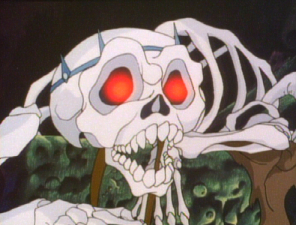
The other film I can only recall fragments of, but has bound me to fantasy nonetheless is The Last Unicorn, animated in 1982. All I can really remember from this film is a scene that I found fully haunting at the time. Before the climax, in a decrepit castle the film's protagonist's are confronted by a sentient skeleton who spoke eloquently but craved wine with absolute depravity. One of the characters remarked something to the effect of, *"but a skeleton doesn't have a tongue to taste." To which the skeleton mentioned something to the effect of, "Just to know that wine runs down my bones brings comfort in memory."* I just remember feeling that this was just such an odd and somehow macabre interaction. I don't want to see these films again because I don't want my perceptions of them to change. I remember them fondly, and hope always to do so.

Picture Link

* Paraphrased.

Tuesday, April 24, 2012

Burning Wheel


Dungeons and Dragons is excellent for labyrinthine treasure-crawls and engaging class-based fantasy battles. But there are serious reasons you should consider Luke Crane's Burning Wheel Gold for your fantasy campaign instead. Both games are fulfilling but approach fantasy radically different. BWG (Burning Wheel Gold) follows a fascinating logic. There are no "classes" or "levels." Characters are woven directly into the world through a "life path" system which solidifies the character's inclusivity in the world as opposed to implying a certain exemplary or disparate status. To improve a skill, the skill must be attempted in-game. Thus players can improve their characters exactly how they see fit by performing the actions they wish to improve. 

Every player character stands somewhere within an integral social structure within an assumed medieval-esque culture. Character's from different walks of life will react to each other and to situations in different and interesting ways that encourage role-play opportunities (think The Canterbury Tales). The game presents a d6 system that can be as simple or as complex as the situation warrants. But fluidity and cinematic logic take precedence over realism. This game is more abstract than many editions of Dungeons and Dragons, which I find refreshing as someone who likes to story tell as though from a novel rather than a board game (I rarely use grids or miniatures and focus the majority of my attention on narrative pace). But there is a significant "crunch-factor" as well for those who prefer detailed combat. Conflict is handled with mechanical intuitiveness whether in ranged combat, brutal melee, or an argument.

The races really shine in this game. Crane indicates in the character creation section ("The Character Burner") that the races are not balanced. Crane suggests that the "races reflect the literature" (or something to that effect. I've paraphrased). I believe he means to imply that more interesting stories might be told the less common ground the player's share. Difference drives development. This is a game about progress and growth, not necessarily power. Emotional magics are race specific and really impressed me the most out of anything in this game. These magics serve to define the races and encourage players to role-play their character's in a way that fully embraces or defies the archetype. The Monster Burner (a separate book) contains my favorite race however, the Great Spiders. 

The Monster Burner is a Burning Wheel supplement which allows gamers to create exactly the kind of fantasy game they want to play. The Monster Burner provides the essential tools to build custom races and monsters in Burning Wheel. This is an excellent idea, because the available PC races in a game often defines the tone of the game more significantly than anything else besides maybe magic. I am currently reading the Monster Burner and the Magic Burner will be next. But even without the supplements, Burning Wheel Gold is a very ambitious and impressive product. 

- J.B. Geany

Monday, April 23, 2012

DnD Next

I'm a sucker for DnD. I got into it as a kid with the third edition box set. Before that I had only played Advanced one time, but it was absolutely that first experience that got me hooked even before I fully understood the fundamentals. I had heard my friend talk about his older brother's cleric like the character was real, someone my friend knew personally. The claims of struggle, leadership, and jewel encrusted weaponry fascinated me, a seventh grader infatuated with the Redwall series and who considered UFO spotting a brave and admirable endeavor. 

As I got older I began exploring DnD's roots. Initially I didn't quite recognize the "old school's" appeal. Now I can't seem to get away from it. Unfortunately my knowledge of old school systems is largely second hand hearsay from various blogs. My actual old school credentials aren't technically credentials at all. My connection to the school is a tenuous one, bridged by various retro-clones. But I've sort of fallen in love with two in particular, Crypts & Things and The Adventurer Conquerer King System

At Pax I attended a Q&A session with two Wizards of the Coast DnD game designers. They were keen on reiterating two fundamental points. First, DnD "needs to be about the people rolling dice around a table -- not about rule mechanics." Perhaps this is why Wizards touts 5e as a unifier system. They mentioned that everyone seems to like "at will spells," but no one likes cumbersome rules nor inadequate challenges. 


Secondly, the designers suggested that the new system would be "modular." This is something I find appealing, and especially if they mean the core books will provide an adequate section on advice for creating custom DM content. But as of now it is much too soon to make any rash predictions. The designers noted that 5e is roughly between 15 and 20 percent done. They also mentioned that in the last play-test clerics did not have "turn undead." I found this highly odd, but I laud the design team's willingness to push conventions for the sake of experimentation. 

*I have paraphrased the Wizards reps' statements to the best of my memory's ability. 

- J.B. Geany

Thursday, January 26, 2012

Best of 2011: Game Supplements (Tie)

Dogs in the Dungeon

        A recent* study suggests dog-people roll natural 20's nearly 33% more frequently than those who identify as cat-people. As the title suggests, Dogs in the Dungeon is a LL supplement geared towards those who want to benefit from the possibilities dogs present in a crawl. When your group's players get creative, the DM might find himself reconsidering his dungeon defenses. Which, I think is a really good thing sometimes.

&

Darker Paths 1 & 2: The Necromancer/ The Witch

        If you like your fantasy dark or morbid, these are great spell casting classes for your game. The spell lists are perfectly tailored for the tone each class evokes. The Necromancer and the Witch are fully actualized classes with unique specializations, strengths, and weaknesses; not mere ripoffs of a classic class. Notably, the folklore is coupled with the art particularly well.

* By "recent" I mean, "made up."

Best of 2011: Fantasy


  LotFP is perhaps my favorite fantasy retro-clone to date. Grindhouse emphasizes player apprehension and uncertainty. The spell list seems straight out of a great old one's grimoire. Magic items are less prevalent than in other fantasy retro-clones, encouraging players to rely on roleplaying wits rather than powerful weapons. Instead of a bestiary, Grindhouse offers excellent advice on creating custom monsters. DnD 5E will have to be DARN good to tear me away from this. 

Wednesday, January 25, 2012

Dungeons & Dragons

Yes this is a sci-fi RPG blog but...
        
        Some recent news from Wizards of the Coast has reverted me to a sub-human forum lurker again. I first heard about Wizards' plans to re-release the first edition ADnD core rulebooks in a post at Grognardia. One of the reasons I play retro-clone roleplaying games is because I do not have access to the original source materials these retro games mimic and alter. 
But even with 1st edition  ADnD soon at my disposal, I certainly wont stop playing retro-clones. For me, getting this first edition is about discerning what Gygax had in mind from the start. My contact with Gygax's writing has been limited. I've leafed through a tattered Advanced DM's Guide at a local hobby shop, I've read a few of his quotes online, even read up on Gygaxian Naturalism - yet I've never owned nor read any of Gygax's works in full. I have only ever played (non-clone) AD&D once, because my roleplaying youth was spent in the 3rd edition era. Even with around a decade of DnD experience, I'm certainly a youngin' compared to the veterans. 
My hope is that this re-release will open a market for other early edition products. I've always wanted to play the original Ravenloft setting (which is AD&D I believe), so my hope is that Wizards is cautiously moving towards this direction. White Wolf Publishing's, Vampire the Masquerade 20th Anniversary Edition seems to be selling quite well in PDF format online. I've seen it featured on DriveThruRPG's "Hottest Items" list for a while now, and I believe Wizards certainly has potential in a similar old school market. 

Wizards has also announced that a fifth edition of Dungeons and Dragons is currently in development. The official announcement is here. I applaud Wizards' approach to the consumer in this endeavor. I've signed up to play-test the upcoming edition, and have been keeping an eye on the forums. Because the wait for news is killing me, I've spent my time developing a list of my most immediate hopes, concerns, and solutions for the edition in development. 

1. Release the fifth edition in an affordable single volume. Impossible? No way. The Dungeons and Dragons Rules Cyclopedia contained everything needed to play the game within only a few hundred pages. I think Wizards would be wise to consider PDF and paperback options as well. Also, release a limited number of leather-bound 5E tomes with a gold leaf title (I'm actually kidding about this, and wouldn't buy it, but it would be cool to know such a thing exists). 

2. Present the "heart" (or skeleton, or frame) of DnD as the "core rules." In addition offer "optional" rules in another section that expand upon the basic. Also be sure to designate which rule options reflect which edition. In this way, a group can custom tailor their game to be exactly as complex or house-ruled as they want it to be. 

3. As far as the art goes, keep the style as cohesive as possible. Alternatively, use a range of art to reflect whatever edition's content is being discussed on the page. Thus, all the decades spanning RPG art could be showcased. Now picture this leather-bound (kind of kidding).

4. Standard races are boring. Offer multiple sub-races. For instance a "wild elf" should differ from a "high elf" if only minutely (I believe 3rd edition started to tackle this issue in the DM's guide). To reflect these differences, different skills and feats should be available to different sub-races. I also want Orcs (not half orcs), gnomes,  and goblins as playable races. 

5. Class trees > prestige classes. Players should be able to craft their rogue in the style of a 3rd edition skill-jockey, a 4th edition striker, or something in between. 4E "multiclass feats" should be fitted into the 5E. Ideally, no one should complain about their fighter "never learning any magic." 

6. Offer DM advice for house-rules, world-building, creating custom classes, creating custom spells, creating custom monsters, and playing monstrous PC's. 

7. More XP should be awarded for completing parts of the story or for getting treasure, and less XP for killing monsters. 

8. Make every level meaningful for every class. Attempt balance, just don't be overly concerned by it.   

9. Ultimately this ruleset should allow "rules light" and "rules crunchy" potential.

10. I want the necromancer and the psion to be playable classes. 

11. Narrative Pace > Rule Realism